
Exploring the Technological Dystopia of World on a Wire

Rainer Werner Fassbinder’s World on a Wire (Welt am Draht), first released in 1973, remains a visionary and thought-provoking exploration of the intersection between technology, reality, and identity. This two-part German television film, based on Daniel F. Galouye’s 1964 novel Simulacron-3, delves into the philosophical implications of simulated realities long before such concepts became mainstream in cinema through films like The Matrix or Inception.
A Groundbreaking Premise
World on a Wire presents a world where a powerful supercomputer, operated by the Institute for Cybernetics and Futurology, houses a virtual reality populated by "identity units." These units are self-aware but oblivious to their existence within a simulation. When Fred Stiller (played by Klaus Löwitsch) assumes leadership at the Institute following the mysterious death of his predecessor, he uncovers unsettling truths about the simulation and its implications for his own reality. The story spirals into a paranoid, mind-bending narrative as Stiller questions whether his own world is part of an even larger simulation.
Themes and Philosophical Undertones
At its core, World on a Wire is a meditation on the nature of reality and the fragility of human perception. Fassbinder explores questions such as: What defines reality? Can a simulated consciousness possess agency (this topic deals with the soul)? And how does power shape our understanding of existence? These questions, presented through a 1970s lens, feel eerily prescient in today’s age of artificial intelligence and virtual worlds.
The film also critiques unchecked technological advancement and its moral implications. The Institute’s researchers, driven by a pursuit of knowledge and power, overlook the ethical ramifications of creating and manipulating self-aware entities. In doing so, Fassbinder comments on humanity’s hubris and the potential dangers of playing God.
Fassbinder’s Visionary Style
Fassbinder’s direction transforms World on a Wire into more than just a science fiction tale—it’s an aesthetic masterpiece. The film’s visual style is striking, characterized by its meticulous use of mirrors, reflective surfaces, and disorienting camera angles. These techniques underscore the film’s themes of duality and deception, visually reinforcing the idea of layers within layers of reality.
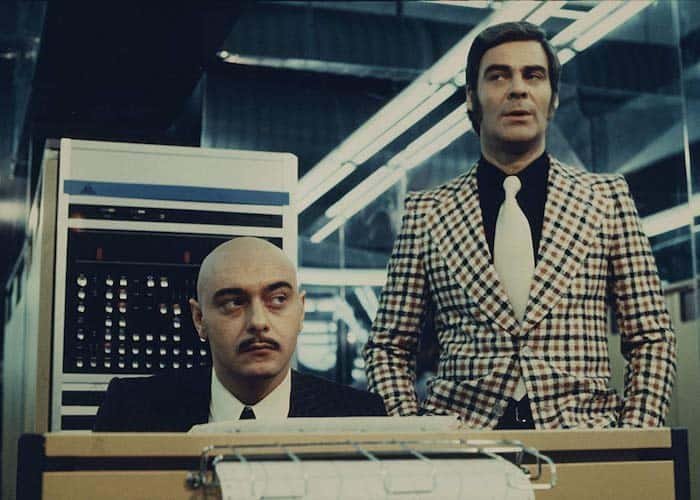
The production design, with its sleek, modernist sets and vibrant color palette, creates a futuristic yet distinctly 1970s world. This blend of retro-futurism adds to the film’s timeless quality, making it as visually compelling today as it was upon its release.
Cultural and Cinematic Legacy
Though relatively obscure for decades, World on a Wire has gained recognition as a pioneering work in science fiction cinema. Its influence can be seen in subsequent films and series that tackle simulated realities and philosophical explorations of consciousness, from The Matrix to Black Mirror. Fassbinder’s adaptation of Galouye’s novel demonstrates how science fiction can serve as a powerful medium for exploring profound existential questions.
In 2010, the film was restored and re-released, introducing it to a new generation of viewers. Critics and audiences alike have since praised its relevance, depth, and artistic merit, cementing World on a Wire as a cult classic.
A Timeless Reflection on Reality
Nearly five decades after its release, World on a Wire remains a compelling exploration of the boundaries between the real and the artificial. Its thought-provoking narrative, combined with Fassbinder’s visionary artistry, challenges viewers to question the nature of their own existence. As technology continues to blur the lines between the virtual and the real, World on a Wire serves as both a cautionary tale and an enduring masterpiece of speculative fiction.